February 29, 2024 by Ben Harry
This semester we are presenting TWO NIGHTS of films celebrating filmmaking in Utah!
YOU WILL NOT WANT TO MISS THIS.
Historical. Fun. Interesting. Entertaining.
Join us, featuring special guests, as we take a walk down memory lane with newly-restored media as it has never been seen before.
FRIDAY – March 8 – 7pm DOUBLE FEATURE
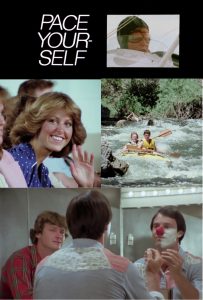
PACE YOURSELF (1979)
A promotional film from the admissions office, showcasing many of the great experiences you can have as a student at BYU!
THE PHONE CALL (1977)
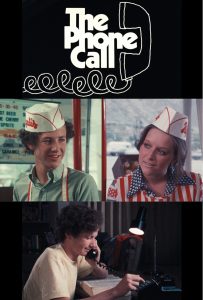
The second premiere on March 8 will be The Phone Call.
A classic film from the BYU Motion Picture studio. A favorite of seminary classes for generations.
Come and see this looking better than ever before!
***********************************************************************
SATURDAY – March 9 – 7pm DOUBLE FEATURE
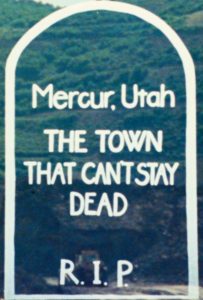
MERCUR: The Town That Can’t Stay Dead (1983)
On the second evening, we will have the premiere of this documentary that tells the story of a mining and ghost town in Utah that has been resurrected multiple times through the decades.
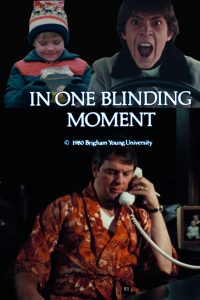
IN ONE BLINDING MOMENT (1980)
Followed by a heartrending film of forgiveness and grace.
**********************************************************************************
FILM RESTORATION AT BYU
At the BYU Motion Picture Archive we have a variety of historical materials.
A special group of materials are those absolutely unique camera original elements that we find in our collections. From these original elements we can now scan with cutting edge technology and see the films of yesteryear as they have never been seen before.
This is film restoration: to go back to a superior source of information so that what was there in the beginning can be brought back and enjoyed in its fulness.
The library offers internships in film restoration to students. We work together to restore titles for which we have the original film materials.
EACH PROGRAM SHOULD RUN ABOUT 90 MINUTES
Utah’s Centennial Cinema Celebration
This year marks the centennial celebration of film and television in Utah (starting in 1924). Year long events are planned to mark this celebration. An exhibit at the state capitol runs the length of the year, highlighting Utah’s celebrated status as America’s Film Set. Featured screenings and events throughout the year are occurring, please checkout this events page to keep up with these happenings.
January 30, 2024 by Ben Harry
The Series
This semester’s presentation for the ARCHIVE CLASSICS FILM SERIES is WAGON MASTER from 1950.
This series features the presentation of cinematic gems held in the BYU MOTION PICTURE ARCHIVE.
These films are esteemed to be of particular importance to BYU Students, focusing on depictions, representations, and expressions of latter-day saints in the medium of the cinema.
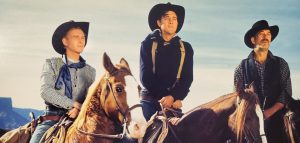
The venerable Western director John Ford features a latter-day saint wagon train as a key component of this film, and his exploration of religious refugees heading to establish their own community is one worthy of watching.
Wagon Master and The World’s Longest Running Film Commission
While filming She Wore a Yellow Ribbon in Monument Valley, John Ford traveled north to an area near the town of Moab to scout out new locations. There he met George White, a local rancher who knew the area well. During Ford’s first visit to scout out locations, White took him to various sites and related the history of the area, including the dramatic stories of settlers coming in their wagons to this rugged country. Ford decided that he would like to tell the story of some of these settlers and film it in some of the locations near where the events had actually taken place. This would be the basis for the film Wagon Master.
White, who owned a ranch in scenic Professor Valley, was a respected member of the community, and developed a personal relationship with Ford that would initially be similar to other personal connections with filming locations that Ford had developed, such as with his location connection in Monument Valley, Harry Goulding.
As they surveyed locations, Ford and White discussed what resources the filmmakers would require, as this would be the first film production in the Moab area and the first time White had facilitated a filmmaking process. The filmmakers would need costumes for the background actors who would be brought in from local communities. They needed lodging for the crew and actors who were coming from Los Angeles. They needed horses, historical-looking buildings, and authentic-looking covered wagons. They also needed roads to be cleared so that buses and trucks could transport the cast and crew to remote locations. White recognized that this would require a coordinated effort. He gathered other community leaders in Moab to informally coordinate the necessary resources.
Moab was a small mining town at this point (1949). We are all aware of the barren and beautiful landscape that surrounds it. This first meeting between John Ford and George White would spark the idea in Grand County residents that their ‘neck of the woods’ could be a filming location destination and bring another source of revenue to locals. They realized that a coordinated effort among the residents was essential to support ongoing filming projects.
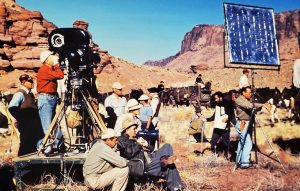
John Ford on set directing WAGON MASTER
Two weeks before the cast and crew for Wagon Master arrived, the Moab Times-Independent printed an article by the editor asking the residents to do their best to make the production a success:
A new enterprise has been launched in Moab, with the coming of Argosy Productions for the filming of a major western feature in this vicinity. If there is a genuine effort by local people to give one hundred cents in services and chattels for every dollar expended by the picture company, then the success of this first picture will be assured, and the chances will be more than favorable for filming many more pictures in this locale. . . Moab has a great opportunity for launching an important new industry here. Let’s don’t muff the opportunity.
“Argosy Productions Will Film Utah Pioneers Picture at Moab.” (1949, October 6). Moab Times-Independent.
To court consistent Hollywood production would require collaboration by the community. Rather than pit independent contractors against each other throughout the region, the Moab Movie Committee was formed in 1949 to formally bring resources together and unify the community. Working with one entity that could collaborate many of these local resources was much simpler for filmmakers and allowed the community to work collectively. The studios preferred to trust a coordinated committee that would charge fair prices in order to attract future collaborations, rather than work with single contractors who might seek a short-sighted overcharge for goods or services.
With the formation of the committee, the town as a whole observed and embraced learning about the Hollywood system so that local resources could be coordinated for subsequent productions as much as possible. They wanted to accommodate more film productions in the future, and by establishing the committee to unify the town, they were poised to support an industry that would outgrow single individuals.
After the wrapping of Wagon Master, the Movie Committee, recognized the need to proactively promote the area if filmmaking was to become a successful industry in eastern Utah. To do so, the committee sent representatives to Hollywood to sell Moab as a film production location. Promotional materials, sponsored by local businesses, outlined amenities like telephones, local extras, equipment, and builders and featured high-quality photographs of the region’s diverse landscapes. Local businesses also donated services to arrange fundraising drives to cover travel expenses to Hollywood for promotional visits. Media production has become a source of income for the region ever since.
The Moab Movie Committee has changed names over the years, but it is now the longest-running film commission in the world. It all started with the production of Wagon Master in 1950.
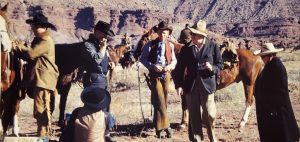
John Ford on set directing WAGON MASTER
Utah’s Centennial Cinema Celebration
This year marks the centennial celebration of film and television in Utah (starting in 1924). Year long events are planned to mark this celebration. An exhibit at the state capitol runs the length of the year, highlighting Utah’s celebrated status as America’s Film Set. Featured screenings and events throughout the year are occurring, please checkout this events page to keep up with these happenings.
The Screening
We will be screening our celluloid print of Wagon Master, so come hear the clatter of the projector, and stop by the booth to see the miraculous technology of yesterday.
A favorite lecturer and speaker for many years, faculty member from the Media Arts Department, Dean Duncan, will provide additional insight into the film.
Come join us as we talk about this film’s history, the portrayal of latter-day saints, and enjoy an evening of discussion and entertainment with an engaged audience.
Friday February 9 Library Auditorium 7:00 pm
November 22, 2023 by Gordon Daines
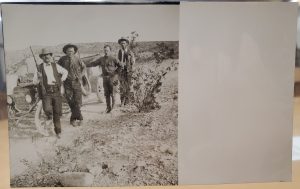
The Mexican Revolution, 1910–1920, overthrew a 30–year dictatorship and established a constitutional republic in Mexico. Mexicans wanted economic change, democratic land policies, and widespread enfranchisement. In 1917, under Venustiano Carranza, a constitution was written, and although it gave the president dictatorial powers, it also gave the government power over groups such as wealthy landowners and the Catholic Church.[1] Fighting continued well into the decade following the creation of the constitution, and an estimated 900,000 people were killed in the revolution conflicts.[2]
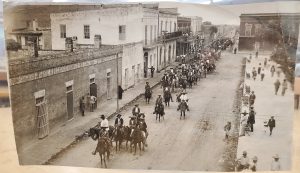
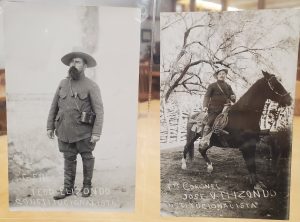 BYU has a collection of eight photographs and eleven postcards (MSS P 249), dating from 1910 to 1917 of the Mexican Constitutional Army and its leaders, including General Teodoro Elizondo, a grocer turned general who aided in the capture of multiple cities,[3] and Colonel Jose V. Elizondo. Many of the images are posed with soldiers in organized rows or blocks, but some are more candid and show the soldiers pouring through the streets of a town or leaning on an automobile in the desert.
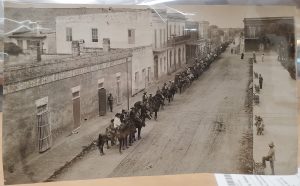
The photos illuminate the Mexican Revolution through their first-hand views of the people in the Constitutional Army and the locations of the revolution. The curated views in the postcards give insight into how the revolution was portrayed at that time, and the photographs offer a more informal perspective on the people involved. The collection is a helpful tool for researchers interested in Mexico’s political history and United States–Mexico relations at the turn of the century. For more information about the collection, please contact Gordon Daines at gordon_daines@byu.edu.
1 “Mexican Revolution,” Encyclopedia Britannica, November 9, 2023, https://www.britannica.com/event/Mexican-Revolution.
[2] “Mexican Revolution | History Detectives | PBS,” n.d., https://www.pbs.org/opb/historydetectives/feature/mexican-revolution/.
[3] “Teodoro Elizondo.” Wikipedia, November 20, 2023. https://en.wikipedia.org/wiki/Teodoro_Elizondo.
November 6, 2023 by Gordon Daines
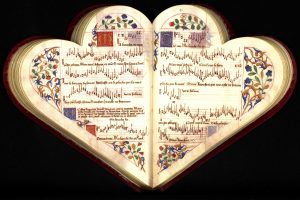
The Chansonnier Cordiforme, also known as the Chansonnier de Jean de Montchenu (M 2 .C42 M66 1460a) is a heart-shaped book of love songs, produced between 1460 and 1477. It contains “fourteen pieces with Italian texts and thirty with French texts,” representing “some of the most popular and widespread chansons of the day, as well as some found only in a few other sources.” Sixteen of the songs are unique to the Chansonnier Cordiforme.[1] A recording of the songs can be found here.
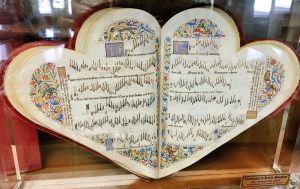
The Cordiforme is printed on parchment bound in red velvet in the shape of a double heart, symbolizing the unity of two hearts in love. The volume is illuminated in the Gothic style with illuminated initials that begin the songs and with flowers, animals, monsters, and people on the borders of the pages. It has two detailed miniatures: an image of a young noblewoman being shot with cupid’s arrow as the goddess Fortuna looks on, and an image of the woman walking arm in arm with a nobleman.[2] Whenever the word for “love” appears in the text, it is replaced with a symbol of a heart.
The Chansonnier Cordiforme was commissioned by Jean de Montchenu, a French clergyman who was reputed to be “an advocate of romantic love between people at the French royal court,” as well as “a great scoundrel, shameful of conduct, highly unchaste, detestable, dissolute, and full of vice.”[3] It was eventually acquired by Baron James de Rothschild and was donated with his library to the Bibliothèque Nationale de France, where it is currently housed.[4] BYU’s facsimile is one of 1380 numbered copies signed by a notary.[5]
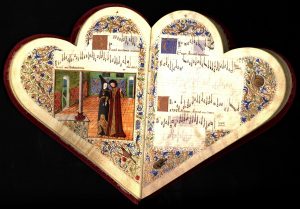
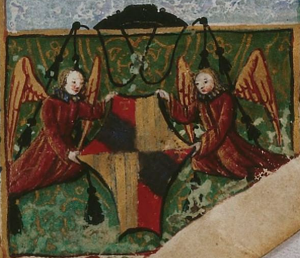
Edward Kottick described how scholars were able to date the Chansonnier using the details of a hat above the heraldry in the Cordiforme: “The black color of the hat indicates that the ecclesiastic station of the wearer was below that of a bishop; the number of tassels on the hat establishes his rank as priest. From study of these details the date of compilation of the manuscript can be fixed: between 1460 and 1476. It is known that before 1460 Jean was only a canon at St. Antoine, and would not have had the priestly number of tassels on his hat. In 1477 he became Bishop of Agen (in title only) and in 1478 was appointed Bishop of Viviers. As a bishop, his hat would have been red, with one more tassel on each side; therefore, he probably acquired the chansonnier prior to 1477.”[6]
If you have any questions about the Chansonnier Cordiforme, please contact the Curator of Music Special Collections at david_day@byu.edu
[1] Edward L. Kottick, “The Chansonnier Cordiforme,” Journal of the American Musicological Society 20, no. 1 (January 1, 1967): 13, 19, https://doi.org/10.2307/830452.
[2] Ziereis Faksimiles, “Chansonnier de Jean de Montchenu,” Ziereis Facsimiles, n.d., https://www.facsimiles.com/facsimiles/chansonnier-de-jean-de-montchenu.
[3] Leech-Wilkinson, Daniel, “Le Chansonnier Cordiforme,” Early Music 9, no. 2 (April 1981): 214, https://www.jstor.org/stable/3126298.
[4] Edward L. Kottick, “The Chansonnier Cordiforme,” Journal of the American Musicological Society 20, no. 1 (January 1, 1967): 10–27, https://doi.org/10.2307/830452.
[5] “Chansonnier de Jean de Montchenu. | BYU Library,” n.d., https://lib.byu.edu/search/byu/record/cat.6343230.item.31197237755225?holding=8prokmzcn7t57mbx.
[6] Edward L. Kottick, “The Chansonnier Cordiforme,” Journal of the American Musicological Society 20, no. 1 (January 1, 1967): 12, https://doi.org/10.2307/830452.
November 1, 2023 by Gordon Daines
Edith M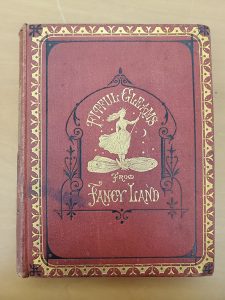 ilner (1845–1921) lived in York, Nun Appleton, England. An 1880 interview for the Women’s Penny Paper reported that her youth was spent in the country “amongst the farmers and peasants, teaching in the schools, training the village choir, [and] visiting the poor and the sick in their homes.” She taught botany at the York Industrial School for Boys, and she worked for the York Charity Organisation Society, which she helped found, and the York Association for the Care of Young Girls. She loved her work at the school and was said to have “immense influence over boys and [could] manage even the most unruly.”[1] She was a Ruling Councillor in the Primrose Society, a conservative political organization, and hosted evening events to display the work of musicians and artists.[2] Milner wrote three fiction titles, The Lily of Lumley, Fitful Gleams from Fancy-Land, and A Sunshine in the Shady Place,[3] and a nonfiction piece, Oberammergau and Its Passion Play.[4]
Fitful Gleams from Fancy-Land is a Victorian children’s book, published in 1874, illustrated with sixteen woodcuts by Mrs. E. Stanhope. The book is a collection of short stories with moral messages to teach children values such as selfless behavior, compassion, and imagination. Milner dedicated the book to Selina Beresford, “child of my early sister-friend,” and “to all my children friends,” whom she invites in the dedicatory poem to “Find in these tales of fairy lore / Truth twined in fancy’s threads of light.”[5]
Of Fitful Gleams from Fancy-Land, a London newspaper wrote, in 1873, “The tales are new and fantastic, full of strange conceits and original devices. The idea is a curious one. Every good and bad instinct holds a certain rank among a bevy of flowers, and the opportunity for instilling serious truths, which this fanciful principle suggests, is by no means lost… The reader may see this style of writing is not calculated to please children—certainly it is not for the romps of the nursery, but we believe there are many thoughtful, grave young ones whom the volume will delight.”[6]
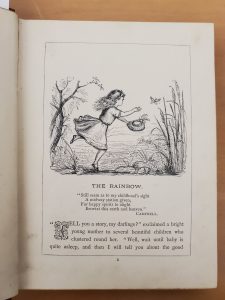
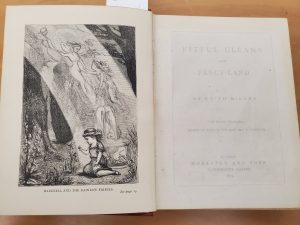
A copy of Fitful Gleams from Fancy-Land can be found in the L. Tom Perry Special Collections with the call number 823 M636f 1874. Patrons interested in more information about the book can contact the curator of rare books, Maggie Kopp, whose email address is maggie_gallup@byu.edu.
[1] Helena B. Temple, editor, “Interview.,” Women’s Penny Paper, June 7, 1890, no. 85, vol. 2. https://access.newspaperarchive.com/uk/middlesex/london/london-women-penny-paper/1890/06-07/.
[2] Fiona Richards, “William Baines and His Circle,” The Musical Times 130, no. 1758 (August 1989): 460–63, https://doi.org/10.2307/1193600.
[3] Troy J Bassett, “Author: Edith Milner,” At the Circulating Library: A Database of Victorian Fiction, 1837—1901, September 5, 2023, http://www.victorianresearch.org/atcl/show_author.php?aid=3829.
[4] “New Books,” London Standard, December 1, 1909. https://access.newspaperarchive.com/uk/middlesex/london/london-standard/1909/12-01/page-5/.
[5] Edith Milner, Fitful Gleams from Fancy-Land (London: Houlston and Sons, 1874).
[6] “Christmas Literature: No. III,” Lloyd’s Weekly London Newspaper, December 21, 1873. https://access.newspaperarchive.com/uk/middlesex/london/lloyds-weekly-newspaper/1873/12-21/page-5/.
October 30, 2023 by Ben Harry
This semester’s presentation for the ARCHIVE CLASSICS FILM SERIES is BAD BASCOMB from 1946.
This series features the presentation of cinematic gems held in the BYU MOTION PICTURE ARCHIVE.
These films are esteemed to be of particular importance to BYU Students, focusing on depictions, representations, and expressions of latter-day saints in the medium of the cinema.
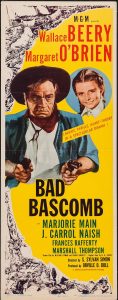
This 1946 Hollywood film follows a murdering bank robber who hides among a Mormon wagon train to escape the authorities in the territory.
He will undergo a surprising transformation through his time among the saints.
A rarely seen Hollywood depiction of latter-day saints in quite a positive light.
And our special guest will be the celebrated Joseph Spencer of the religion department.
You don’t want to miss this.
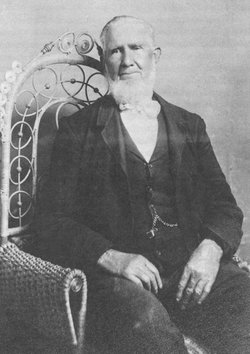
Elias Hicks Blackburn (1827-1908)
BYU Special Collections is pleased to announce the availability of a newly digitized collection: Elias Blackburn papers (Vault MSS 785). This collection contains records on the early ecclesiastical history of Provo, Utah. Records include accounts of sermons of the period by several prominent leaders of the Church of Jesus Christ of Latter-day Saints during the Mormon Reformation of 1856-1857, and document the response of the community, including rebaptisms and Church disciplinary matters. Also includes Blackburn’s personal family record, and records of donations by Loa (Utah) Ward members for the building of the Manti Temple during Blackburn’s tenure as bishop. The dates of materials in the collection span 1851 to 1887.
Elias Hicks Blackburn was born 17 September 1827 in Bedford County, Pennsylvania, to Thomas Blackburn and Elizabeth Bone. He was baptized into the Church of Jesus Christ of Latter-day Saints in April 1845. After his baptism, he assisted with the construction of the Nauvoo Temple and in 1846 took part in the Saint’s exodus west. Elias Blackburn twice served as a bishop in the Church. He was called as the first bishop of Provo, Utah Territory, in 1851. Blackburn was appointed bishop of Loa, Utah, in 1879, although he was not formally set apart until 1885. He served in that capacity until 1889. He was married to six plural wives in his lifetime. Elias Hicks Blackburn died at Loa, Utah, on 6 April 1908.
October 4, 2023 by Ben Harry
This semester we are presenting a DOUBLE FEATUE of films dealing with the topic of marriage.
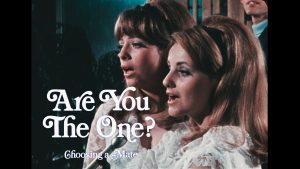
In 1968, the BYU Motion Picture Archive in collaboration with the school of family sciences produced a film providing guidance in choosing a marriage partner.
ARE YOU THE ONE? -Choosing a Mate-
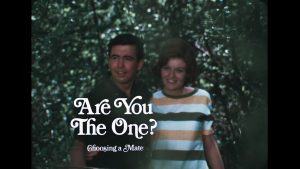
This is really fun and is an absolute time machine to bring us back to 1968.
Special guests anticipated!
**********************************************************************************
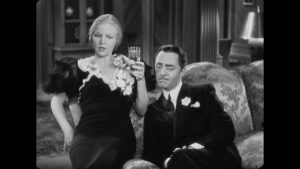
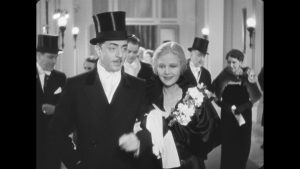
Our second feature in DOUBLE HARNESS from 1933.
Ulterior motives complicate romance in a marriage, but what IS marriage in the 20th century?
William Powell and Ann Harding star in this pre-code drama. Come see this film in a newly-restored state!
**********************************************************************************
FILM RESTORATION AT BYU
At the BYU Motion Picture Archive we have a variety of historical materials.
A special group of materials are those absolutely unique camera original elements that we find in our collections. From these original elements we can now scan with cutting edge technology and see the films of yesteryear as they have never been seen before.
This is film restoration: to go back to a superior source of information so that what was there in the beginning can be brought back and enjoyed in its fulness.
The library offers internships in film restoration to students. We work together to restore titles for which we have the original film materials.
On October 13, we present our next RESTORATION SHOWCASE
YOU WILL NOT WANT TO MISS THIS.
Historical. Fun. Interesting. Entertaining.
Join us, and some special guests, as we take a walk down memory lane with newly-restored media as it has never been seen before.
September 21, 2023 by Ben Harry
 Silent Movie Day is an international celebration of Silent Films.
It began in 2021 and this year marks the third anniversary. Each year the BYU Motion Picture Archive has joined in the celebration.
Silent Movie Day is set on the calendar as September 29th each year, and we try and do what makes sense to our calendar at BYU. So we are doing a few things to celebrate that beautiful early cinema that relied upon images to tell a story (helped by title cards here and there).
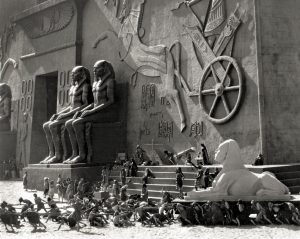
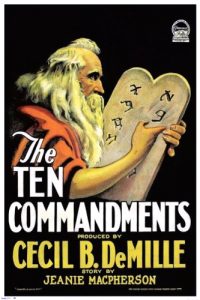 THE TEN COMMANDMENTS (1923) 100th anniversary screening of Cecil B. DeMille’s first attempt at creating the greatest cinematic epic of its time. DeMille is credited with releasing the first feature film in Hollywood history THE SQUAW MAN (1913), and ever since he was continuing to present lavish productions based both in modern settings and from historical moments. With TEN COMMANDMENTS we get both of those worlds, where half the film is the telling of the tale of how ancient Israel was brought out of bondage by God’s own hand, and then it flips to demonstrate how the commandments are applicable today in lives of every person, “You cannot break the Ten Commandments – They will break you.”
Thursday September 28th at 7:30 pm in the Library Auditorium
(10 minute presentation, runtime 2hr 23 min)
_______________________________________________________________________
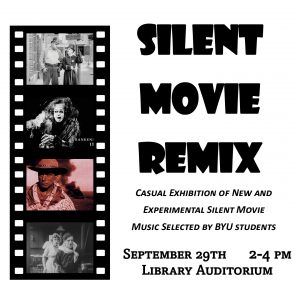
SILENT MOVIE REMIX – Join us for an exhibition of silent shorts and a feature put to music by BYU students. Silent movies may not have had synchronized sound, but they were practically always presented with some kind of musical accompaniment. BYU students have needle-dropped music from any era they choose to accompany the silent imagery to come up with new and innovative ways to underscore the onscreen drama. Come and watch a few shorts or stay for the whole program!
Friday September 29th from 2:00 – 4:00 pm in the Library Auditorium
We hope you will come and join us for a celebration of these amazing artworks from yesteryear!
*Parking lot restrictions are lifted at 7pm, we are trying a start time a little later so that more parking freedom is available.
September 9, 2023 by Ben Harry
Thursday afternoons this fall semester, THE BYU MOTION PICTURE ARCHIVE will be running vintage films on celluloid film in the library’s auditorium.
We discuss the historical context, cultural context, narrative themes, and form connections with the past.
This gives us a chance to explore a film together in a historical way: together with an audience.
Please consider stopping in some time to see what film we are watching.